The Greater Phoenix real estate market is doing something very Phoenix-like right now: cooling off a little, but definitely not getting cold.
The latest numbers through September 15, 2026 show home values losing a little momentum compared with earlier this year, while pending sales are beginning to hint that the market may be finding its footing.
For buyers and sellers trying to figure out what comes next, the short version is this:
Prices have softened, but there are some early signs that the summer slide may be leveling out.
Let’s take a look.
Greater Phoenix Home Prices Slipped Slightly in September
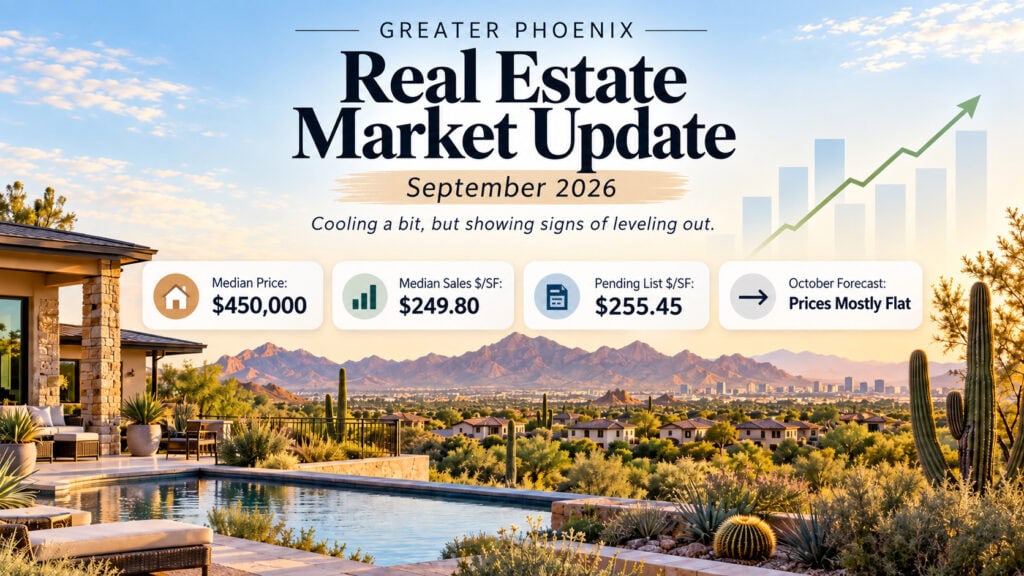
Across all property types and areas in the ARMLS database, the median sales price per square foot came in at:
$249.80 per square foot
That is down 0.9% from $252.14 one month earlier.
It is also now slightly below where we were one year ago. In September 2025, the median was $251.77 per square foot, meaning the market is currently about 0.8% lower year over year.
That is not exactly a market crash.
It is more like the market taking its foot off the gas after several years of unusually dramatic real estate headlines.
The decline was a little stronger than expected. The forecast called for approximately $251 per square foot, with the actual number landing near the lower end of the projected range.
The Median Home Price Is Holding Up Better
Here is where things get interesting.
Even though the price-per-square-foot numbers slipped, the overall median sales price actually increased.
The current Greater Phoenix median home price is:
$450,000
That compares with:
- $449,000 last month
- $446,650 one year ago
So while buyers may have a little more negotiating room in certain parts of the Valley, the typical sales price has remained remarkably steady.
This is also a good reminder that there is no single number that tells the entire story of a real estate market.
Home size, location, property type and the mix of homes selling in any particular month can all influence the numbers.
Pending Sales Are Showing a Little More Strength
One of the more encouraging numbers this month comes from homes currently under contract.
On September 15, the median list price per square foot for properties under contract was:
$255.45 per square foot
That is up 0.8% from $253.40 on August 15.
More importantly, this is the first monthly increase since May.
The average list price per square foot for homes under contract also increased, rising about 2% to $319.48.
In other words, both measurements moved higher.
Could this be the beginning of a fall rebound?
It is still too early to declare victory, but after several months of declining numbers, seeing the pending pipeline move higher is certainly worth watching.
What Could Happen to Phoenix Home Prices in October?
The current forecast for October 15 calls for median sales pricing of approximately:
$250 per square foot
The projected range is $247 to $253 per square foot.
The median sales price is projected to remain around:
$450,000
So the most likely near-term scenario is not a dramatic increase or decline.
It is something considerably less exciting:
A relatively flat market.
And after the price declines we saw through portions of the summer, flat may actually be fairly welcome news for homeowners.
The Market Indicators Aren’t Exactly Agreeing
This is where real estate forecasting gets a little messy.
Some indicators are beginning to look better.
Pending contracts are firmer, and historically we often see a modest seasonal improvement between September and October. Those signals suggest pricing could land closer to $251 per square foot.
Statistical models, however, continue to put more weight on the steady price declines we have experienced since spring. Those models suggest something closer to $248.
Splitting the difference gets us to the current $250 forecast.
The important takeaway?
The rate of decline appears to be slowing.
That could indicate that Greater Phoenix home prices are beginning to establish a floor as we move into the fall market.
Luxury Home Sales May Give the Market a Boost
Another factor to watch over the next couple of months is the luxury market.
Higher-priced properties typically make a larger contribution to Greater Phoenix sales statistics as we move deeper into fall.
If luxury sales increase, they can help push Valley-wide pricing measurements higher even if many individual neighborhoods remain relatively flat.
This is also why buyers and sellers should be careful when looking at large Metro Phoenix statistics.
The market for a $500,000 home in North Phoenix can behave very differently from the market for a $2 million home in Scottsdale or Paradise Valley.
Real estate is local — sometimes extremely local.
What About Foreclosures and Distressed Properties?
There has also been some attention recently on the gradual increase in distressed property activity.
Among homes currently under contract:
94.7% are normal sales.
Approximately:
1.5% are REO properties, and
3.8% are pre-foreclosures, including a very small number of short sales.
Those percentages are almost unchanged from last month.
That means the recent increase in pre-foreclosure activity paused during September.
However, it is worth continuing to monitor.
One year ago, normal listings represented 97.4% of homes under contract, and distressed activity has been gradually increasing since 2022.
That said, some perspective is important.
Distressed sales remain very low by historical standards.
We are nowhere near the foreclosure environment Greater Phoenix experienced during the housing crisis.
For now, I would describe this as something worth watching rather than something buyers or homeowners should panic about.
What Does the Greater Phoenix Real Estate Market Mean for Buyers?
For buyers, the current environment can actually present some opportunities.
Homes are generally not appreciating at the rapid pace we experienced a few years ago, which means buyers have more time to evaluate properties and negotiate.
Depending on the home and neighborhood, buyers may also have opportunities to negotiate:
Seller concessions
Interest-rate buydowns
Repairs
Closing costs
Price reductions
The key is understanding how much leverage exists on the specific property, not simply assuming every seller is desperate to negotiate.
Some homes are still attracting multiple buyers.
Others have been sitting for months.
What Does This Market Mean for Sellers?
For sellers, pricing correctly from the beginning continues to be extremely important.
Buyers have more inventory to choose from and are paying close attention to value.
A home that is priced properly, presented well and marketed aggressively can still sell very successfully.
A home that starts significantly above market value may find itself chasing the market downward with repeated price reductions.
In today’s market, the first couple of weeks on the market matter.
That is when a property is newest, gets the most online attention and has the best opportunity to create urgency among buyers.
The Bottom Line on Greater Phoenix Real Estate
The Greater Phoenix housing market continues to cool modestly, but September brought a few encouraging signs.
Median price per square foot slipped to $249.80, while the overall median sales price held firm at $450,000.
More importantly, the prices of homes currently under contract moved higher for the first time since May.
That does not necessarily mean home prices are about to surge.
But it may mean the summer decline is beginning to run out of steam.
As we move into fall, the Greater Phoenix market looks less like it is falling and more like it is trying to find its balance.
And in real estate, sometimes boring and balanced isn’t such a bad thing.
Thinking About Buying or Selling in Greater Phoenix?
Metro-wide statistics can give us the big picture, but your neighborhood, price range and property type can tell a very different story.
If you’re thinking about buying or selling a home in Phoenix, Scottsdale, Paradise Valley or the surrounding Greater Phoenix area, I’d be happy to help you look at the numbers that actually matter for your specific situation.