
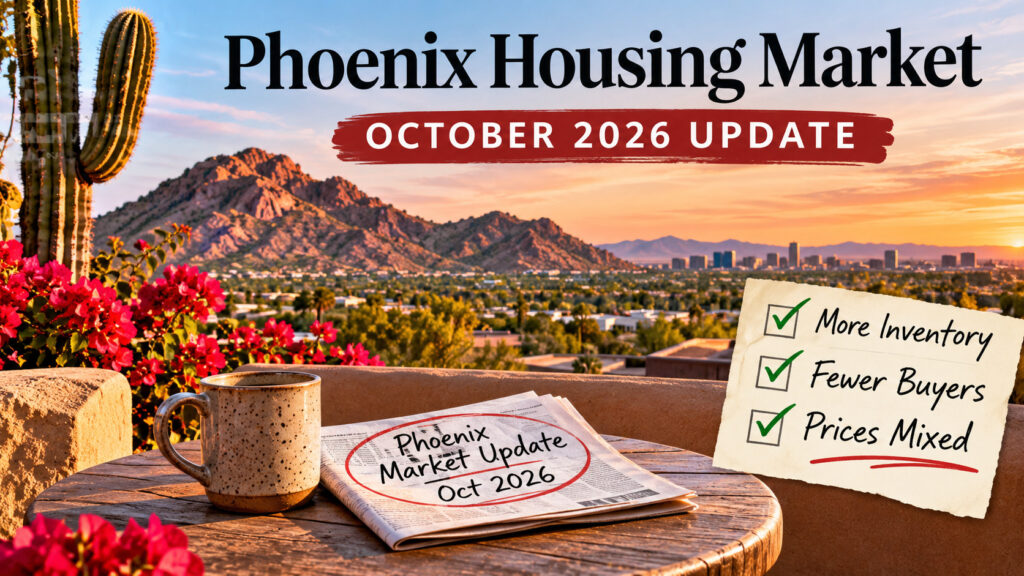
The Greater Phoenix real estate market has entered November with a whole lot of homes for sale, some hesitant buyers, and prices that are sending mixed signals. Let’s make some sense of it!
Well, folks, it’s November in the Valley of the Sun. The mornings are finally cool enough to enjoy coffee on the patio, the snowbirds are finding their way back to Arizona, and our real estate market is doing something rather interesting.
It’s giving buyers more choices while making sellers work a little harder to get that SOLD sign in the front yard.
If you’ve been keeping an eye on the Phoenix housing market, you may be wondering whether it’s finally a buyer’s market, whether prices are falling, or whether everybody has simply decided to take a little break before the holidays.
Grab your coffee. Let’s dig into the October 2026 numbers!
Phoenix Housing Inventory: Plenty of Homes to Choose From!
Let’s start with the big one.
At the end of October, the Greater Phoenix market had 28,107 active listings, excluding homes under contract with certain contingencies.
That’s an increase of:
- 8.3% compared with October 2025
- 9.6% compared with September 2026
Now, that’s quite a jump in just 30 days!
Think of it like showing up at your favorite neighborhood restaurant and discovering that, instead of waiting for a table, you’ve suddenly got your pick of the entire dining room.
That’s pretty much what today’s homebuyers are experiencing in many parts of the Valley.
More homes mean more choices, less pressure to make an immediate decision, and potentially more negotiating opportunities.
For sellers, however, it means your home has a little more competition down the street.
And that makes pricing, presentation, and marketing more important than ever.
Where Have All the Homebuyers Gone?
Here’s where things get interesting.
While the number of homes for sale is growing, the number of homes going under contract is moving in the opposite direction.
October recorded:
- 3,411 pending listings, down 19.7% from last year.
- 5,705 listings under contract, down 22.3% from October 2025.
- 5,140 closed sales, down 16.8% year over year.
That’s not exactly a stampede of buyers rushing through open houses!
Some folks may be waiting for mortgage rates to improve. Others might be watching home prices, weighing economic uncertainty, or simply deciding that their current home will do just fine for another year.
Whatever their reasons, the numbers show that buyers aren’t moving with the same urgency we saw a year ago.
There’s also a seasonal element to consider. Real estate typically slows as we approach the holidays, although October’s year-over-year declines suggest there’s more happening than just the usual autumn slowdown.
The good news? Homes are still selling. Buyers are still buying. The market hasn’t stopped; it’s simply become more selective.
Phoenix Home Prices: Up, Down, or Sideways?
Now comes my favorite part of this month’s report.
Depending on which number you look at, you might think Phoenix home prices are rising or falling.
And technically, you could make a case for both!
The median sales price in Greater Phoenix dropped to $444,000 in October.
That’s down from $450,000 in both September 2026 and October 2025, a decline of 1.3%.
But hold on to your coffee cup.
The average price per square foot actually climbed to $304.65, up 3.8% from October 2025 and 3.9% from September.
How in the world does that happen?
Well, real estate numbers aren’t always as straightforward as they appear.
One explanation could be the mix of homes selling. Changes in the locations, sizes, and price ranges of homes closing escrow can influence the median sales price and average price per square foot differently.
A greater proportion of smaller, more expensive-per-square-foot homes, for example, could help produce this result.
The important takeaway is that Greater Phoenix home prices aren’t moving uniformly.
What’s happening in a luxury Scottsdale neighborhood may be completely different from what’s happening in a starter-home community in Glendale or a newer subdivision in Chandler.
That’s why I believe neighborhood-level numbers are far more useful than relying on one Valley-wide statistic.
Sellers, That Price Tag Better Be Right!
Here’s a number that caught my attention.
The Greater Phoenix listing success rate dropped to 62.9% in October, compared with 68.9% one year earlier.
That’s a meaningful decline.
It suggests that getting a home sold has become more challenging.
Buyers have options, and they’re taking advantage of them.
The days of putting a home on the market at an ambitious price and simply hoping someone comes along may be catching up with some sellers.
We’re also seeing approximately 146 days of inventory, up from about 135 days in September.
That’s nearly five months of supply at the reported sales pace.
In other words, there’s no shortage of homes for buyers to consider.
But here’s something sellers should find encouraging.
Homes that closed in October sold for an average of 97.28% of their final list price.
That figure has remained remarkably stable compared with last year.
So while fewer listings are successfully making it to closing, homes that do sell are still closing relatively close to their final asking prices.
The lesson?
Price it right. Prepare it well. Market it professionally.
A home that checks those boxes still has a solid opportunity to attract the right buyer.
Buyers, This Might Be Your Kind of Market!
If you’ve been sitting on the sidelines waiting for a little breathing room, you may want to pay attention.
Compared with the frenzied markets of years past, today’s Greater Phoenix housing market offers some attractive possibilities.
With more inventory, fewer competing buyers, and slower sales activity, buyers may have opportunities to:
- Compare several homes without feeling quite so rushed.
- Negotiate on price, repairs, or closing costs.
- Consider builder incentives and mortgage rate buydowns.
- Take more time to evaluate the neighborhood and property.
Now, does that mean every seller is desperate to negotiate?
Of course not!
Some homes are still attracting plenty of attention, particularly when they’re priced correctly, beautifully maintained, and located in desirable neighborhoods.
But buyers generally have more leverage than they did when inventory was scarce.
And that’s a welcome change.
What’s Ahead for the Phoenix Housing Market?
As we head toward the end of 2026, I’m watching three important things.
First, inventory. Will the number of homes for sale continue climbing, or will we see the usual seasonal pullback?
Second, buyer activity. Pending contracts and listings under contract have declined considerably. I’d like to see those numbers stabilize before calling this a meaningful market turnaround.
Third, pricing. With the median price slipping and the average price per square foot rising, it’s particularly important to follow what’s happening in individual neighborhoods and price ranges.
Mortgage rates, the broader economy, and the return of seasonal residents could all influence activity as we move into winter.
But I wouldn’t bet the farm on any one prediction.
Real estate has a funny way of surprising us.
My Take: There’s Opportunity on Both Sides of the Yard
After nearly 30 years working in Greater Phoenix real estate, one thing I’ve learned is that there’s no such thing as a one-size-fits-all market.
A buyer looking for a condo in Scottsdale faces a very different set of circumstances than someone shopping for a luxury estate in Paradise Valley.
And a homeowner selling in North Central Phoenix might need a completely different strategy from a seller in Desert Ridge.
What October’s numbers tell me is that this is a market that rewards preparation, patience, and good information.
For buyers, opportunities are opening up.
For sellers, success increasingly depends on realistic expectations and an effective marketing strategy.
And for anybody wondering whether now is the right time to make a move?
Well, that depends a whole lot more on your particular circumstances than any headline about the Phoenix housing market.
If you’re thinking about buying or selling in Scottsdale, Phoenix, Paradise Valley, or the surrounding communities, I’d be happy to help you make sense of what’s happening in your neighborhood.
Because in real estate, knowing the market is important.
Knowing your market is what really matters.
Market data: October 2026 Greater Phoenix ARMLS market statistics, provided November 6, 2026. Figures reflect the market categories reported in the source data.